Most building owners are surprised to learn that roof systems may account for up to 33% of building energy losses, which means your commercial roof is often the biggest opportunity to cut energy costs without disrupting daily operations.
By focusing on the top energy-saving commercial roof strategies, you can reduce utility bills, improve comfort for tenants and staff, and extend the life of your roof system at the same time.
Related Helpful Question & Answers
| Question | Answer |
|---|---|
| What are the most effective energy efficient upgrades for commercial roofs? | Upgrading commercial roof insulations, installing commercial cool roofs, improving ventilation, and preparing the roof for solar are among the most effective strategies. Our overview of energy-efficient roofing in San Diego explains how we combine these upgrades in real projects. |
| How much can insulation upgrades save on energy bills? | Upgrading roof insulation to modern standards can save up to 11% of annual energy costs, especially when installed during a reroofing project. To understand how this fits into your budget, see our guide on commercial roof costs in San Diego. |
| Are cool roofs worth it for commercial buildings? | Yes, commercial cool roofs reflect more sunlight and absorb less heat, which can significantly reduce cooling loads and extend roof life. We cover the basics and options in our cool roof energy saving roof technology resource. |
| When should I replace vs. repair my commercial roof for better energy efficiency? | If your roof is near the end of its life or has widespread issues, a full replacement with modern materials, insulation, and ventilation often delivers better long-term energy savings. Our commercial roof replacement page explains how we approach this decision. |
| Do I need inspections before planning energy efficient upgrades? | Yes, a detailed inspection helps us locate leaks, insulation gaps, and heat-loss areas so we can prioritize the right upgrades. Learn how regular assessments can prevent surprise costs in our article on commercial roof inspections. |
| Which flat roof materials are best for energy efficiency? | TPO and PVC membranes with reflective surfaces, combined with proper insulation, are among the top energy-saving commercial roof strategies for flat roofs. We compare options in our guide on the best material for a flat roof. |
1. Why Energy Efficient Commercial Roof Upgrades Matter For Your Bottom Line
When HVAC accounts for roughly a third of a building’s energy use, every degree your roof helps keep out of the building has a direct impact on monthly bills.
Top energy-saving commercial roof strategies focus on stopping unwanted heat gain in summer and reducing heat loss in cooler months while keeping your roof durable and watertight.
We see three core benefits for business owners when we design for commercial roof energy efficiency:
- Lower utility bills and more predictable operating costs
- Improved comfort for employees, tenants, and customers
- Longer roof life by reducing thermal stress and UV damage
In Southern California-style climates, reflective materials, well-planned commercial roof insulations, and cool roof systems are usually the highest-return upgrades.
If you are already planning a reroof or addressing leaks, it often costs only a little more to choose higher efficiency materials, yet the savings continue for decades.
2. Cool Roofs: Reflective Systems That Cut Cooling Costs
Cool roofs are one of the most straightforward commercial roof energy efficiency upgrades, especially in sunny markets.
By increasing solar reflectance, they send more sunlight back into the atmosphere instead of allowing your building to absorb it as heat.
How Commercial Cool Roofs Work
Cool roofing uses light-colored or specially formulated surfaces that stay cooler under the same sun compared to traditional dark roofs.
This helps your HVAC system work less, and it reduces temperature swings that stress roofing materials.
Key benefits of commercial cool roofs include:
- Lower interior temperatures, particularly on top floors
- Reduced cooling load for rooftop units and split systems
- Potential extension of roof life through reduced heat aging
In some buildings, cool roof coatings or reflective membranes can reduce cooling energy use by well into the double digits, especially on older, dark roofs.
Our Focus On Cool Roof Technology
We design cool roof systems that pair reflectivity with durability, proper flashing, and long-term maintainability.
This can involve installing a new reflective membrane, using cool-rated shingles, or applying a cool roof coating to an existing flat roof when appropriate.
3. Commercial Roof Insulations: Stopping Heat Before It Enters
If cool roofs are about reflecting sunlight, commercial roof insulations are about slowing down heat that still tries to get inside.
Insulation is the “hidden” upgrade that helps year-round, not just in peak summer months.
Insulation As A Top Energy-Saving Strategy
A well-insulated commercial roof limits heat transfer, so your HVAC system runs less and maintains a more stable indoor climate.
Many older buildings have far less insulation than current standards recommend, which leaves easy savings on the table.
Typical insulation strategies for commercial roofs include:
- Adding polyiso insulation boards above the deck during reroofing
- Improving tapered insulation design to promote drainage and performance
- Ensuring continuous insulation at edges and transitions to avoid thermal bridges
We often find it is cost effective to increase insulation thickness slightly during a planned reroof, since the crew is already mobilized and tear-off is happening anyway.
Why Code Updates Matter For Insulation
Energy codes continue to raise expectations for roof insulation levels.
Upgrading to higher R-values now can help you avoid future surprise costs and can qualify your project for certain incentives or rebates.
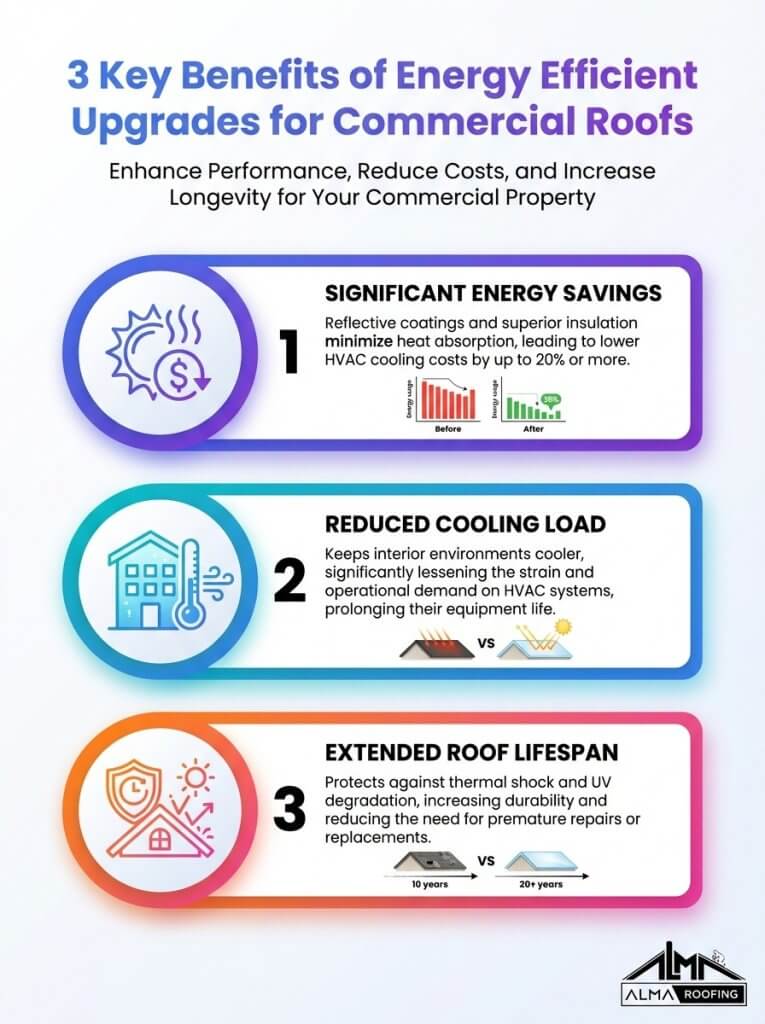
This infographic highlights three key benefits of energy-efficient upgrades for commercial roofs. It explains how improved insulation, reflective materials, and efficient systems save energy and boost ROI.
Did You Know?
Upgrading roof insulation to code-compliant levels can save up to 11% of annual energy costs, especially when combined with reroofing projects and available tax incentives.
Source: Buildings.com
4. Choosing Energy Efficient Materials For Flat Commercial Roofs
Flat and low-slope roofs dominate many commercial properties, from warehouses to retail centers.
Material choice here has a major effect on commercial roof energy efficiency because of surface color, thickness, and how the system is installed.
Top Flat Roof Materials For Energy Performance
When we evaluate flat roof options, we look at their reflectivity, durability, and compatibility with added insulation.
Common choices include:
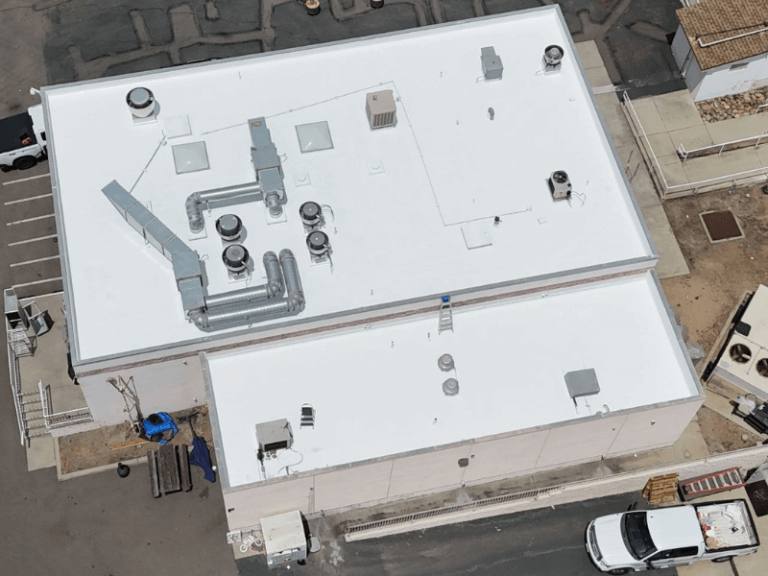
- TPO membranes with white reflective surfaces, often a leading choice for energy efficiency
- PVC roofing, also highly reflective and chemical resistant
- Modified bitumen systems with cool roof coatings where appropriate
For many buildings, a white TPO or PVC system installed over adequate insulation achieves both durability and strong energy performance.
Balancing Cost, Longevity, And Efficiency
We help owners weigh upfront material costs against expected roof life, maintenance needs, and energy savings.
While some reflective membranes may cost slightly more per square foot than darker options, they can pay that difference back over time through reduced cooling expenses.
5. Sloped Commercial Roofs: Shingles, Tile, And Reflective Options
Not every commercial roof is flat, especially in mixed-use buildings, small offices, and schools.
For sloped roofs, we still focus on commercial roof energy efficiency, using reflective products and proper attic or plenum design.
Cool Shingles And Reflective Assemblies
Reflective asphalt shingles, such as COOL-rated products that meet California Title 24, are a strong upgrade over traditional dark shingles.
They are formulated to reflect more of the sun’s energy while still offering attractive color blends that fit commercial architecture.
Tile and metal roofs can also be configured as commercial cool roofs when paired with reflective surfaces and vented assemblies.
The goal is always the same: reduce surface temperatures and heat flow into the structure without sacrificing style or durability.
Real-World Commercial Roof Upgrade Examples
On education and office buildings, we routinely replace worn shingles with reflective shingle systems combined with upgraded underlayments and ventilation.
This type of project often delivers a noticeable improvement in interior comfort on the top floor and can reduce HVAC runtime during hot afternoons.
6. Ventilation, Underlayment, And Details That Boost Efficiency
Energy efficient upgrades for commercial roofs are not only about the main surface material.
The supporting components, such as ventilation and underlayments, also play an important role in performance.
Attic And Roof Space Ventilation
On sloped roofs, proper attic ventilation helps move hot air out of the roof cavity.
This reduces heat transfer down into occupied spaces and also protects materials from moisture buildup.
In many reroofing projects, we improve ridge and intake ventilation so the entire system works more efficiently.
On some flat roofs, we focus more on insulation continuity and air sealing rather than traditional vented cavities.
High-Performance Underlayments And Flashings
Modern synthetic underlayments and self-adhered membranes can add a layer of protection that supports both durability and efficiency.
Dry, well-protected assemblies perform more consistently over time, which contributes to steady energy performance year after year.
Carefully detailed flashings around penetrations, walls, and skylights help prevent leaks that could damage insulation or interior finishes.
Those details make a real difference in how well an energy efficient roof performs over its full service life.
7. Cost Of Energy Efficient Commercial Roof Upgrades
When owners ask about top energy-saving commercial roof strategies, the next question is almost always cost.
Most commercial reroofing in our market generally falls somewhere in the $5.00 to $15.00 per square foot range, depending on size, material, and complexity.
What Drives Cost For Energy Efficient Upgrades
Several factors impact your final investment:
- Existing roof type and condition, including any required tear-off
- Choice of membrane or shingle system, and whether it is cool-rated
- Amount and type of new insulation added
- Number of penetrations, skylights, and edge details
Adding insulation or choosing a cool roof system adds some cost but can be modest compared to total project scope.
When energy savings and longer roof life are factored in, these upgrades often provide a better life-cycle cost than a basic replacement.
Planning For Long-Term ROI
We help clients compare scenarios, such as a minimal-code roof versus an enhanced insulation and cool roof package.
By looking at estimated energy savings over 15 to 25 years, many owners choose the more efficient option because the operating savings offset much of the initial premium.
Did You Know?
Roof systems may account for up to 33% of building energy losses, so upgrading to high-performance roofs can meaningfully improve overall building efficiency and comfort.
Source: Better Buildings, U.S. DOE
8. Maintenance, Inspections, And Protecting Your Efficiency Gains
Even the best commercial cool roofs and insulation systems need routine care to keep performing.
Deferred maintenance can lead to leaks that damage insulation, which directly reduces commercial roof energy efficiency.
Why Regular Inspections Matter
We recommend scheduled commercial roof inspections to catch issues early.
Small membrane punctures, clogged drains, or failed sealant can quickly become larger problems if left unaddressed.
An inspection program supports:
- Longer roof lifespan and better warranty compliance
- Preservation of insulation R-value and reflective properties
- Reduced risk of interior damage and business disruption
When we inspect, we also look for signs of ponding water, UV wear, and any areas where previous energy-saving details may be compromised.
Cleaning And Minor Repairs
Simple actions, such as keeping drains clear and removing debris, help your roof shed water properly.
On cool roofs, periodic cleaning can also maintain reflectivity in dusty or pollution-prone environments.
9. Planning A Commercial Roof Replacement With Energy Efficiency In Mind
If your building is due for a new roof, this is the ideal time to incorporate energy efficient upgrades.
A planned commercial roof replacement lets us integrate insulation, cool roofing, and ventilation into a single coordinated system.
Our Step-By-Step Approach
When we plan energy efficient upgrades for commercial roofs, we typically:
- Inspect and document the existing roof, insulation, and problem areas
- Discuss your goals for energy savings, budget, and long-term use of the building
- Recommend materials and commercial roof insulations that fit your climate and roof type
- Provide a clear, detailed proposal with options and warranties
We also plan phasing and scheduling to minimize disruption to your tenants or operations.
On many projects, we can complete a full commercial reroof in a matter of days, depending on size and complexity.
Title 24 And Local Energy Requirements
For California and similar markets, energy codes like Title 24 influence required reflectivity and insulation.
We make sure your new roof is compliant and, where practical, we design above code minimums when that adds clear value for your building.
10. Integrating Solar With Energy Efficient Commercial Roofs
Energy efficient upgrades for commercial roofs and solar often go hand in hand.
A cool, well-insulated, watertight roof is the best foundation for a long-lasting rooftop solar array.
Solar-Ready Roof Design
When clients are considering solar, we coordinate roof replacement and solar planning together.
This avoids unnecessary penetrations and ensures your warranty and solar mounting system work together.
A reflective roof surface can also improve solar performance by keeping panel temperatures lower, which supports better output in some conditions.
At the same time, your building benefits from both on-site power generation and reduced cooling loads.
Lifecycle Perspective For Building Owners
When you look at energy costs over 20 years, combining commercial roof energy efficiency upgrades with solar can provide a strong financial story.
Lower demand from efficient roofing plus on-site solar production helps protect you from rising electricity rates and adds resilience to your building.
Energy efficient upgrades for commercial roofs are no longer optional improvements, they are a practical way to control operating costs, improve comfort, and protect your investment.
By combining commercial cool roofs, upgraded commercial roof insulations, smart material choices, and consistent maintenance, we help building owners get the most value out of every square foot of roof.
If you are evaluating top energy-saving commercial roof strategies for your property, the best next step is a detailed roof inspection and a clear, tailored plan.
Our team is committed to designing roofs that are built right, energy efficient, and ready to serve your building for the long term.