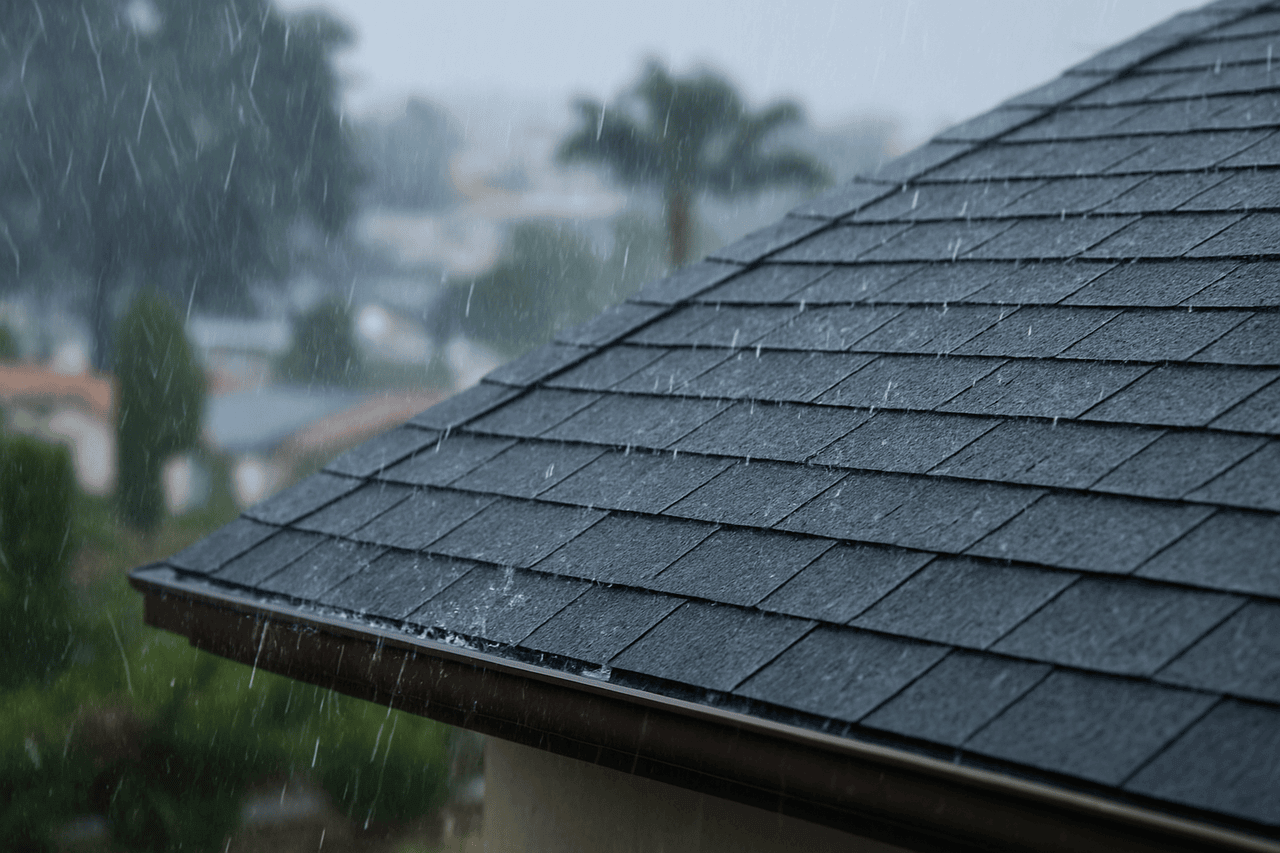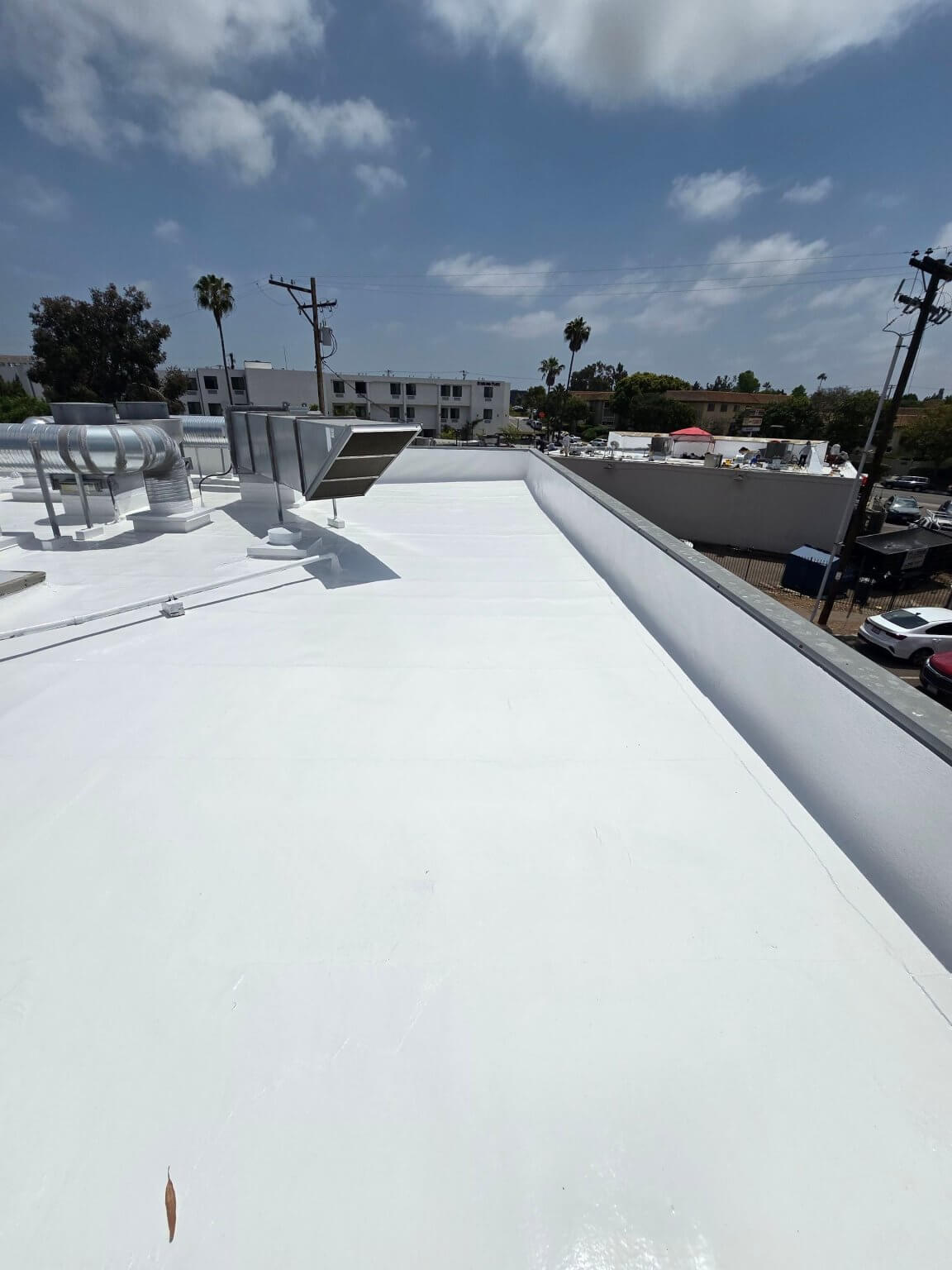

When it comes to top reliable emergency roof repair solutions for commercial buildings, the stakes are high and the clock is always ticking. More than 80% of all commercial roofs are replaced prematurely, meaning most building owners are spending far more than necessary simply because they lack a fast, informed response plan when damage strikes. As a locally owned and operated San Diego commercial roofing company, we understand exactly what commercial property owners need when the unexpected happens.
| Question | Answer |
|---|---|
| What counts as a commercial roofing emergency? | Active leaks, structural damage after storms, exposed decking, fallen debris, or any situation that puts the building’s interior or occupants at risk. |
| How fast should emergency roof repair begin? | Response should begin within hours. Our 24/7 emergency roofing service in San Diego County means a licensed team is always ready to mobilize. |
| What are the most reliable emergency repair methods for commercial flat roofs? | Emergency tarping, membrane patching (TPO, EPDM), flashing repair, and temporary sealants are the most proven first-response solutions. |
| Can I prevent commercial roofing emergencies? | Yes. Scheduled professional roof inspections and proactive maintenance dramatically reduce the risk of sudden failures. |
| When does emergency repair lead to full replacement? | When the damage covers more than 25% of the roof surface, structural decking is compromised, or repeated repairs have failed to hold. |
| Does a licensed contractor matter for commercial emergency repairs? | Absolutely. A licensed roofing company (such as our C-39 License #1115855) ensures code compliance, quality materials, and backed workmanship warranties. |
| How do I request a professional roof health assessment? | Contact a trusted local roofing company, describe your building type and any visible issues, and schedule a documented inspection to benchmark your roof’s current condition. |
Why Reliable Emergency Roof Repair Solutions for Commercial Buildings Are Critical in 2026
Commercial buildings face unique roofing challenges that residential properties simply do not. Larger footprints, flat or low-slope designs, HVAC equipment penetrations, and high foot traffic on the roof surface all create more points of vulnerability.
In 2026, roofing material and labor costs continue to rise, making a fast, accurate emergency response more financially important than ever. The longer a roof failure goes unaddressed, the more the damage spreads into interior walls, electrical systems, inventory, and structural components.
We have seen firsthand how a small, ignored leak at a San Diego commercial property can spiral into a costly structural repair within weeks. Acting fast with the right solution is not just good practice; it protects the entire investment.
Best for Immediate Response: Emergency Tarping and Leak Containment
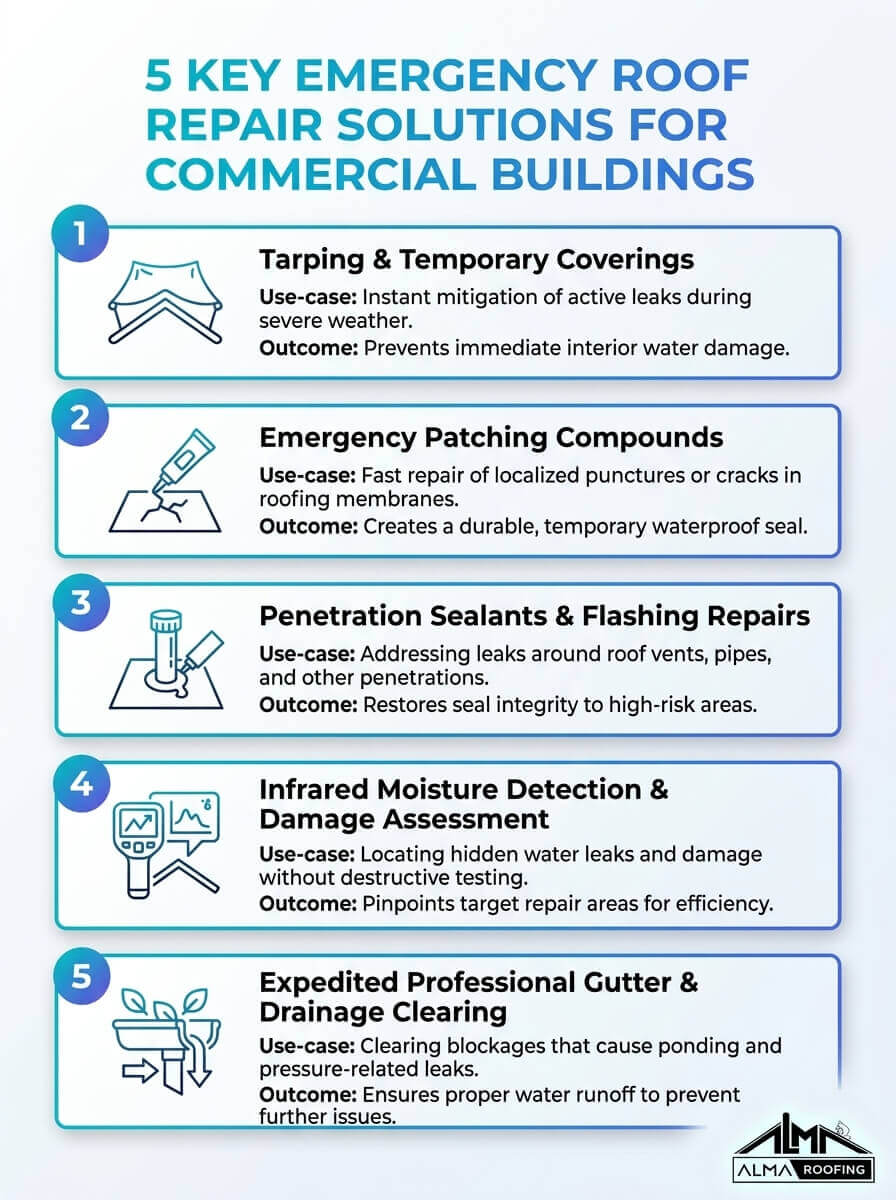
The very first step in any reliable emergency roof repair solution for commercial buildings is stopping the water intrusion. Emergency tarping is the industry-standard first-response measure when a roof has been breached by storm damage, fallen debris, or sudden membrane failure.
A properly installed commercial tarp covers the damaged area, redirects water away from the breach, and buys time for a full assessment and permanent repair. It is a temporary measure, but when done correctly, it prevents thousands of dollars in secondary interior damage.
Here is what a professional immediate-response process looks like:
Step 1 – Emergency call and dispatch: A licensed technician is sent to your location, available 24 hours a day, 7 days a week.
Step 2 – Safety assessment: The team evaluates the structural integrity of the roof before anyone goes up.
Step 3 – Temporary tarping or sealant application: Heavy-duty tarps or emergency sealants are applied to stop water entry immediately.
Step 4 – Documented inspection: All damage is photographed and documented to support insurance claims and plan permanent repairs.
Step 5 – Written repair scope: A clear, itemized repair proposal is provided so building managers can make informed decisions.
Our emergency roof repair team in San Diego follows this exact process to make sure your commercial property is protected from the moment we arrive.
Best for Hidden Leaks: Advanced Roof Inspection Technologies for Commercial Buildings
Not every roofing emergency announces itself with visible water pouring through the ceiling. Many of the most damaging commercial roof failures begin as hidden moisture problems trapped beneath the membrane, invisible to the naked eye until serious structural damage has already occurred.
In 2026, advanced inspection technologies have made it faster and more affordable than ever to find these hidden problems before they become emergencies. Two methods stand out as the most reliable:
- Infrared thermography: Thermal cameras detect temperature variations caused by trapped moisture. Infrared thermography can identify hidden moisture problems with a precision level exceeding 90% accuracy, often finding water trapped under the membrane months before a visible leak appears.
- Drone visual inspection: 4K drone inspections cover large commercial roof surfaces in 30-45 minutes compared to 8-12 hours for traditional manual methods, delivering 75-80% cost savings over scaffolding-based surveys.
Combining both methods gives building managers a comprehensive picture of their roof’s condition without disrupting daily operations or putting workers at risk on large, potentially unstable surfaces.
Best for Flat Roof Emergencies: TPO and EPDM Membrane Repair Solutions
The majority of commercial buildings in San Diego and across California rely on flat or low-slope roof systems. These include TPO (Thermoplastic Polyolefin), EPDM (Ethylene Propylene Diene Monomer), and modified bitumen membranes, and each requires a specific repair approach during an emergency.
Here is a quick comparison of emergency repair approaches by membrane type:
| Membrane Type | Common Emergency Issue | Reliable Repair Method |
|---|---|---|
| TPO | Seam separation, punctures | Heat-welded patch or seam tape |
| EPDM | Shrinkage, tears, lap failures | EPDM patch with contact adhesive |
| Modified Bitumen | Blisters, cracking, ponding damage | Torch-applied or cold-process patch |
| Built-Up Roofing (BUR) | Gravel displacement, felt layer separation | Flood coat and gravel resurfacing |
Ponding water that stays on a flat commercial roof for more than 48 hours is a primary trigger for accelerated membrane deterioration. This 48-hour benchmark is why our team prioritizes drainage clearance and membrane integrity as the first checks during any flat-roof emergency visit.
Best for Storm Damage: Wind and Impact Emergency Repairs for Commercial Buildings
High winds, falling tree limbs, and hail present a different category of challenge for commercial property managers. Unlike slow-developing leaks, storm damage is sudden, often widespread, and frequently affects multiple areas of the roof at the same time.
Reliable emergency roof repair solutions for commercial buildings after storm events typically include a combination of:
- Emergency tarping over exposed decking or torn membrane sections
- Flashing repair and re-securing around HVAC units, skylights, and parapet walls
- Debris removal to assess the full scope of damage and prevent further punctures
- Fastener and seam reinforcement where wind uplift has compromised the membrane edge
- Documented damage reports for insurance claim submission
We always provide a detailed written assessment after storm emergencies, because your insurance carrier will need clear documentation to process a commercial claim efficiently.
Best for Long-Term Protection: Proactive Maintenance as a Reliable Emergency Prevention Strategy
The most cost-effective emergency roof repair solution is the one you never have to make. Proactive maintenance schedules are the single most powerful tool commercial building owners have to reduce the frequency and severity of roofing emergencies.
A well-structured maintenance program for a commercial building should include the following at minimum:
- Bi-annual professional roof inspections (spring and fall)
- Post-storm inspection within 48 hours of any significant weather event
- Drain and gutter clearing to prevent ponding water accumulation
- Flashing and sealant condition checks around all penetrations
- Membrane surface inspection for cracks, blistering, or UV degradation
“Simple, clear, and dependable maintenance plans are not an expense; they are insurance against the far greater cost of reactive emergency repairs. Every commercial property in San Diego deserves a documented maintenance schedule.”
Our guide to repairing commercial roofs outlines the exact markers our team looks for during each scheduled visit, so building managers know precisely what is being evaluated and why.
How to Request a Professional Roof Health Assessment to Benchmark Your Commercial Roof’s Condition
A professional roof health assessment is the most direct way to understand your building’s current vulnerability level and establish a clear benchmark before an emergency occurs. Think of it as a physical for your roof: comprehensive, documented, and actionable.
Here is our straightforward three-step process for requesting and completing a professional commercial roof health assessment:
Step 1 – Submit your request.
Contact our roofing company directly by phone or through our online request form. Provide your building address, roof type (flat, low-slope, or pitched), approximate square footage, and any known issues or recent weather events that may have affected the roof.
Step 2 – On-site inspection and documentation.
A licensed inspector visits the property and performs a full surface walk, checks all penetrations, inspects flashing, evaluates drainage systems, and reviews the underside of the roof deck where accessible. All findings are photographed and recorded in a written report.
Step 3 – Receive your benchmarking report and recommended action plan.
You receive a clear, prioritized report that scores your roof’s condition, identifies any areas at risk of emergency failure, and outlines recommended repairs in order of urgency. This report becomes your baseline for future inspections and serves as supporting documentation for insurance policies.
This process gives building managers and facility directors a factual starting point, so decisions about repairs, maintenance budgets, or replacement planning are based on real data rather than guesswork.
Scheduling a professional roof inspection is the single best thing a commercial property owner can do before a problem forces their hand.
Best for Budget Management: Reducing the Cost of Emergency Repairs on Commercial Buildings
That 25-50% emergency premium covers immediate mobilization, after-hours labor, and expedited material sourcing. These are costs that can be significantly reduced or avoided entirely with a planned inspection and maintenance approach.
Here are practical steps commercial building managers can take right now to reduce their exposure to emergency repair premiums:
- Establish a maintenance contract with a trusted local roofing company for regular check-ups.
- Keep a repair history log for your building so recurring problem areas are flagged early.
- Address minor issues immediately rather than deferring them to the next budget cycle.
- Maintain clear roof drains to prevent ponding water from accelerating membrane failure.
- Review your building’s insurance policy annually to confirm roof damage is covered and documentation requirements are met.
The average annual cost to proactively maintain a commercial roof is $0.14 per square foot, versus $0.25 per square foot for reactive repairs. On a 50,000 square foot facility, that difference translates to over $5,500 in savings every single year before any emergency event is factored in.
Warning Signs That Your Commercial Building Needs Emergency Roof Repair Now
Every reliable emergency roof repair solution for commercial buildings begins with recognizing the warning signs early. Waiting until a ceiling collapses or inventory is ruined is not a strategy; it is a preventable financial loss.
Watch for these indicators and contact a roofing company immediately if you notice any of them:
- Active water intrusion through the ceiling, walls, or around light fixtures during or after rain
- Sagging or soft spots in the ceiling, which indicate saturated insulation or decking
- Visible membrane bubbling, cracking, or separation observed during a visual roof walk
- Standing water on a flat roof that has not drained within 48 hours of the last rainfall
- Flashing pulled away from walls, curbs, HVAC units, or skylights
- Interior mold or mildew smell without an obvious source near plumbing
- Visible daylight through roof boards when inspecting the underside of the deck
- Gutters pulling away from the building or showing signs of overflow damage to the fascia
If your commercial building is showing any of these signs, our roof leak response team can assess the damage quickly and provide a clear repair path.
Best for Complete Overhauls: When Emergency Repair Leads to Commercial Roof Replacement
Sometimes the most reliable solution is not a patch or a temporary fix. When the damage is too widespread, when repeated repairs have failed, or when the underlying structure has been compromised, a full commercial roof replacement becomes the most responsible path forward.
In 2026, commercial roof replacement systems offer building owners significant long-term value that emergency repairs cannot provide on their own. Modern commercial roofing materials include:
- TPO single-ply membranes with energy-reflective properties that reduce cooling loads in San Diego’s warm climate
- EPDM systems with 20-plus year life expectancy when properly installed
- Modified bitumen for multi-layer durability on high-traffic commercial roofs
- Commercial shingle systems for pitched commercial structures requiring aesthetic and functional upgrades
Our commercial roof replacement service includes clear guidance on material selection, timelines, and warranty options so building managers can make confident decisions without confusion.
We always provide a full written scope of work before any replacement begins, because you should never go into a major project without knowing exactly what you are getting and what it will cost. That is what “simple, clear, and dependable” means to us in practice.
What Makes a San Diego Roofing Company the Right Choice for Commercial Emergency Repairs
Not every roofing contractor is equipped to handle the speed, scope, and documentation demands of a commercial roofing emergency. Choosing the right company means looking for specific qualities that directly affect the outcome of your repair.
Here is what to look for when evaluating a roofing company for commercial emergency work:
| Quality | Why It Matters |
|---|---|
| 24/7 availability | Emergencies do not happen on business hours. Rapid response limits secondary damage. |
| State contractor license (C-39) | Confirms the company meets California’s legal and safety requirements for roofing work. |
| Commercial roofing experience | Commercial systems differ significantly from residential; experience with TPO, EPDM, and flat roofs is essential. |
| Documented inspection reports | Critical for insurance claims and for tracking the repair history of your building. |
| Transparent written estimates | Prevents surprise costs and sets clear expectations for scope and timeline. |
| Warranty on repairs | Demonstrates confidence in workmanship and gives building managers ongoing protection. |
As a locally owned and operated San Diego roofing company, we check every one of these boxes. We hold a C-39 License (#1115855) and are fully insured, with a team that is built around rapid, quality responses for commercial clients across San Diego County.
Alma Roofing Is Your Trusted Partner for Top Reliable Emergency Roof Repair Solutions for Commercial Buildings
When a roofing crisis hits your commercial property, you need a team you can call at any hour, a company that knows exactly what to do, and a partner that values your time, your budget, and your peace of mind. That is what we deliver every single day.
The top reliable emergency roof repair solutions for commercial buildings are not complicated in principle: respond fast, document everything, apply the right repair method for your specific roof system, and follow up with a proactive maintenance plan that prevents the next emergency from happening.
In 2026, San Diego commercial property owners have more tools, more technology, and more options than ever before. But the foundation of a sound roofing strategy is still the same: a trusted, experienced local roofing company that treats your building with the same care we bring to every project we take on.
We are here, 24 hours a day, 7 days a week. Whether you need an immediate emergency response, a professional roof health assessment to benchmark your building’s condition, or a long-term maintenance plan that keeps emergencies off your calendar, our team is ready to help.
Request your commercial roof repair consultation today and let us show you what simple, clear, and dependable looks like in action.